Guides · Getting started
How to Start an Import Export Business: First Steps
A plain first-year plan to start an import-export business: prepare, pick a market, learn the rules, and ship with the right documents.
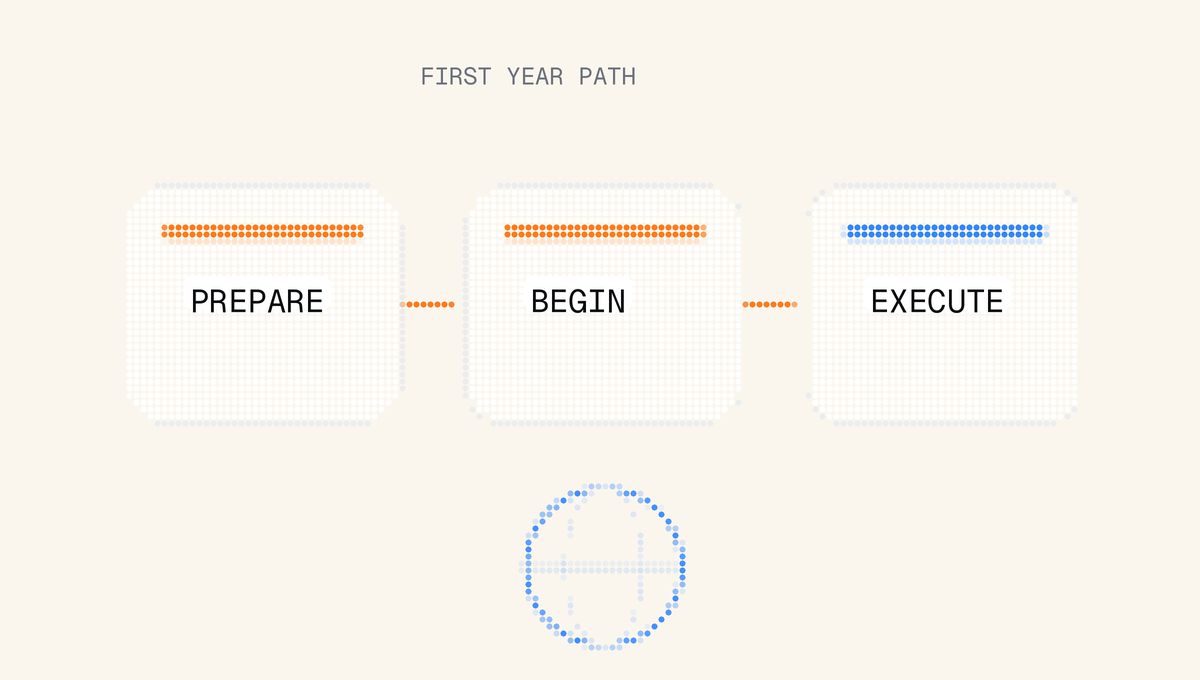
How to start an import export business: prepare your company and a simple export (or import) plan, pick one product and one market, learn the rules that apply to that path, then run a first shipment with the right documents and payment terms. This guide covers the general steps and points you to official country resources. It is not legal advice for any single country—confirm registration, licenses, and tax rules with your local authorities or a qualified adviser.
What does starting an import-export business involve?
At a high level you are building a repeatable path to sell or buy goods across a border: a legal business, a product you understand, a market you can research, partners who move and clear cargo, and a document set that matches what customs and the buyer expect.
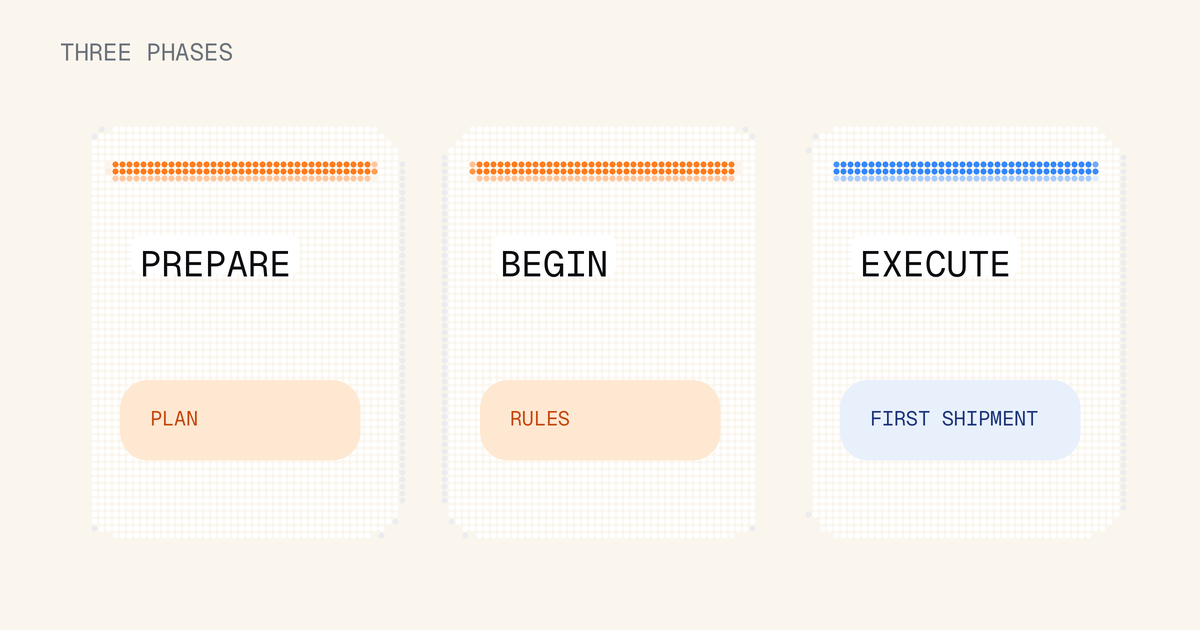
ITA’s Learn How to Export guide groups the work into three phases that travel well as a checklist even if you are not a U.S. exporter: prepare (commitment, plan, local help), begin (markets, contracts, product standards, export-country rules), and execute (buyers/partners, foreign import rules, documents and shipping). The WTO’s handbook for businesses engaging in international trade is another official overview for smaller firms.
If your first year is mostly importing, start from your customs authority’s new-importer guidance as well—for example CBP’s tips for new importers and exporters and basic import and export pages for the United States.
How do you prepare before the first deal?
- Decide what you are starting. Export from your home market, import into it, or both. The paperwork and partners differ; pick one path for the first shipment.
- Register the business properly at home. Form, tax ID, and any local business licence follow your country’s company and tax rules—not this guide.
- Check whether you are ready. ITA offers exporter assessments (new / expanding / experienced) so teams can see gaps before they spend on a market. Use a similar honest checklist even if you use another country’s tools.
- Write a short plan. ITA’s prepare phase stresses creating an export plan and tapping local assistance (Learn How to Export; introductory planning services). Cover product, target market, how you get paid, who ships, and who owns compliance.
- Name your helpers early. Freight forwarder, customs broker (where used), bank, and—when needed—a trade lawyer or accountant. CBP notes that many first-time U.S. importers and exporters consult a licensed customs broker, and that the importer of record stays responsible for the entry even when a broker files.
How do you pick a first product and market?
Keep the first year narrow: one product family, one destination (or one origin).
For a non-U.S. example of pairing a product with a market, UK guidance walks exporters through classifying the goods first—if you are exporting chocolate, you need to know whether it contains added cereal, fruit or nuts—then checking duties, rules and restrictions for that product in the destination country.
| Step | What to do | Official starting points |
|---|---|---|
| Choose the product | Something you can specify, source, and support | Your own catalog / supplier specs |
| Screen the market | Demand, standards, logistics, and competition | ITA research center; Country Commercial Guides for documentation chapters |
| Check foreign import rules | Customs docs, product standards, labelling | ITA foreign regulations; your buyer’s customs broker |
| Check your export-country rules | Licenses, screening, declarations | ITA U.S. export regulations overview + BIS if you are exporting from the U.S.; otherwise your national export-control authority |
| Price the landed deal | Product + freight + insurance + duties/taxes + banking | Official tariff/duty tools in the buyer’s country; do not invent rates |
ITA’s export process overview frames the same questions: readiness, market entry, finding buyers, getting paid, and shipping the goods.
For market and buyer research once you are past the basics, EximAgent’s agents can help your team find markets and buyers.
What rules and documents should you learn first?
Learn the document set and the control rules before you book freight.
Documents (every commercial shipment, in broad terms): commercial invoice, packing list, and a transport document for your mode—see ITA’s common export documents. Work through our export documentation checklist, then the field detail in proforma invoice vs commercial invoice and packing list for export.
Payment: ITA’s methods of payment page outlines cash-in-advance, letters of credit, documentary collections, open account, and consignment, and stresses choosing a method that balances your risk with the buyer’s needs. New exporters often prefer advance payment; buyers often push for freer terms—agree this in writing before production.
Export controls and declarations: Whether a license is required depends on the product, destination, end use, and end user. For U.S. exports, start from ITA’s U.S. export regulations overview and the Bureau of Industry and Security. Other countries have their own authorities—use them; do not copy another country’s checklist blindly.
Import side (if you import): CBP states it does not require a general importer license for merchandise into the United States, but other agencies may require permits by commodity, and local or state business licences may still apply. Parallel rules exist elsewhere—check the destination customs site.
EximAgent doesn't prepare the documents themselves. When you want a second pass on classification and duties, EximAgent Compliance checks HS codes and duties; your team still owns the filing.
How do you run the first shipment?
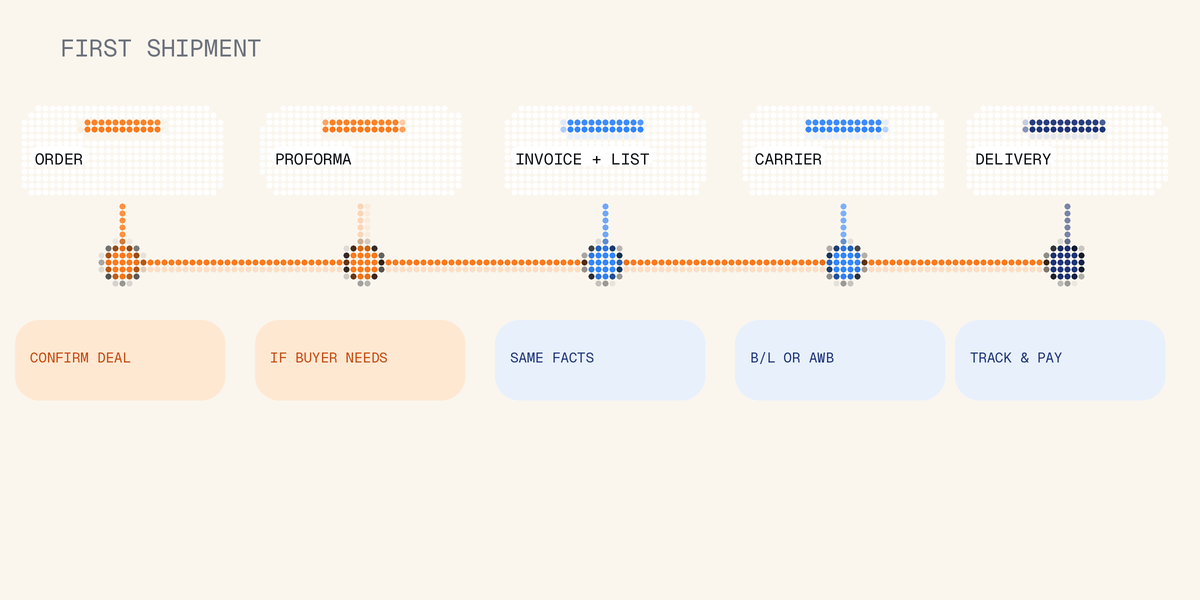
- Confirm the order — product, quantity, Incoterm and named place (Know Your Incoterms summarizes ICC rules via ITA), payment method, and delivery window.
- Issue a proforma if the buyer needs it for a license, letter of credit, or funds transfer (ITA pro forma).
- Book freight with a forwarder who knows the lane.
- Prepare the commercial invoice and packing list together, then the transport document instructions—see the export documentation checklist.
- Add destination extras early (certificate of origin, inspection, and similar) using ITA’s special documents guidance and the buyer’s list.
- File any required export declaration in your country (for U.S. physical exports, ITA summarizes EEI/AES rules on common export documents—confirm thresholds and exemptions with your forwarder).
- Ship, then track payment and delivery against the contract.
After the first shipment, write down what broke (missing certificate, weight mismatch, payment delay) and turn it into a short checklist for shipment two.
Where do you find official country resources?
Use government and customs sites for the country you trade with—not random blogs—for registration, licences, and duty rules. Examples of official starting points (not an exhaustive list, and not endorsements of every page on those sites):
| Need | Example official starting points |
|---|---|
| Export how-to / planning (U.S.) | Learn How to Export, Export Solutions |
| U.S. import/export basics | CBP basic import and export, importer/exporter tips |
| U.S. export controls | BIS, ITA U.S. export regulations |
| Destination docs & standards | ITA Country Commercial Guides, foreign regulations |
| UK export overview | Export goods from the UK (GOV.UK) |
| Cross-border MSME overview | WTO business handbook (PDF) |
Always confirm the live page for your product and corridor. Rules change; this article does not replace a broker, lawyer, or accountant.
If your firm later wants help adopting AI for trade workflows (not the first-shipment checklist), see EximGPT’s AI consultation page.
FAQ
Do I need a special licence to start an import-export business?
Often you need ordinary business registration at home, plus product- or destination-specific permits when a regulator requires them. For U.S. imports, CBP does not require a general importer license, but other agencies may. For exports, license needs depend on the item and destination (ITA U.S. export regulations). Check your own country’s authorities.
Should I start with import or export?
Either can work. Pick the path where you already understand the product and can reach a customer or supplier. Run one corridor first; do not launch many markets in month one.
What documents do I need for the first shipment?
Plan on a commercial invoice, packing list, and the carrier’s transport document, then add what the destination asks for (ITA common export documents). Use our export documentation checklist.
How should a new exporter get paid?
ITA describes a spectrum of methods from cash-in-advance (lower seller risk) to open account and consignment (higher seller risk). Choose a method both sides accept and put it in the contract before you produce or ship.
Where can new trade teams go next?
Start free with EximAgent: Analyst finds the market and buyers, and Compliance checks HS codes and duties before you ship.
Sources
- ITA, Learn How to Export — verified HTTP 200
- ITA, Export Process Overview — verified HTTP 200
- ITA, Exporter Assessments — verified HTTP 200
- ITA, Introductory services — plan and assess — verified HTTP 200
- ITA, Research Center — verified HTTP 200
- ITA, Foreign Regulations — verified HTTP 200
- ITA, U.S. Export Regulations — verified HTTP 200
- ITA, Common Export Documents — verified HTTP 200
- ITA, Methods of Payment — verified HTTP 200
- ITA, Know Your Incoterms — verified HTTP 200
- ITA, Special Documents — verified HTTP 200
- ITA, Country Commercial Guides — customs documentation — verified HTTP 200
- ITA, Pro Forma Invoice — verified HTTP 200
- CBP, Basic Import and Export — verified HTTP 200
- CBP, Tips for New Importers and Exporters — verified HTTP 200
- BIS, Bureau of Industry and Security — verified HTTP 200
- UK Government, Export goods from the UK — verified HTTP 200
- UK Government, Check duties and customs procedures for exporting goods — verified HTTP 200
- WTO, Handbook for businesses and entrepreneurs to engage in international trade (PDF) — verified HTTP 200