Guides · Export paperwork
Packing List for Export: Format and Field Checklist
What goes on an export packing list, how it differs from a commercial invoice, and a field checklist to match your shipment.
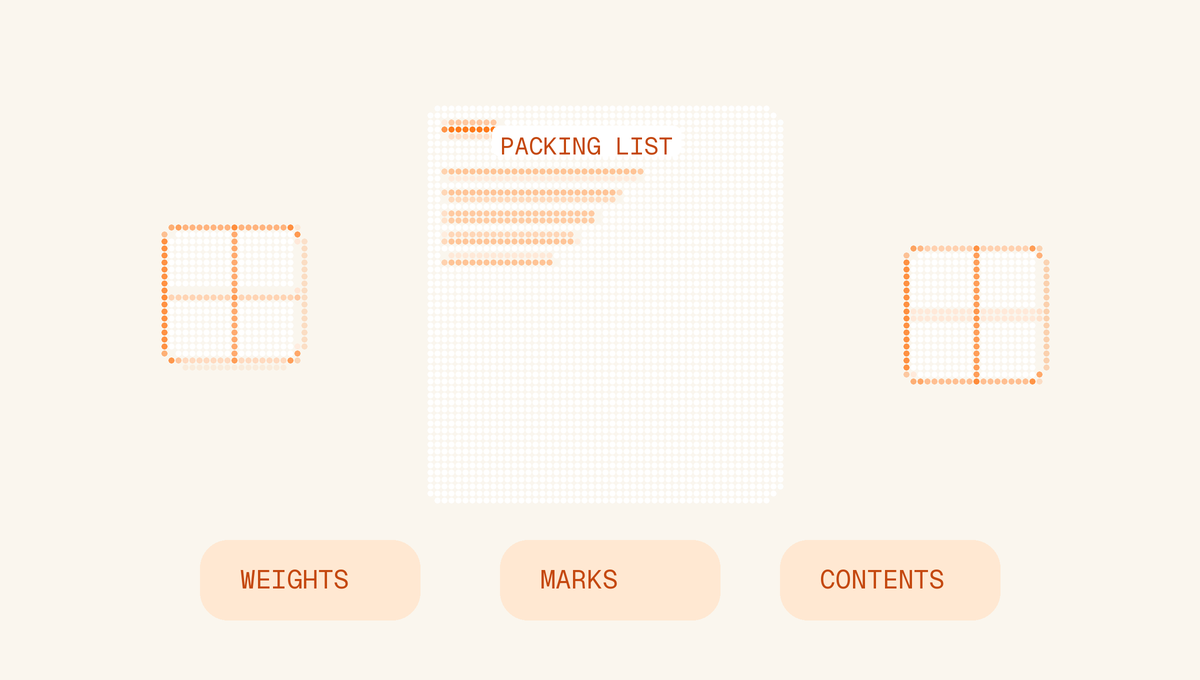
An export packing list itemizes what is inside each package—weights, measurements, and a detailed list of the goods—so freight forwarders can plan the shipment and customs can check the cargo. It is more detailed than a domestic packing slip, it is not a substitute for the commercial invoice, and the two documents should agree. Use the field checklist below when you build or review yours.
What is a packing list for export?
ITA’s packing list page describes it as a document that itemizes the contents of each package (boxes, pallets, and similar units), including weights, measurements, and detailed lists of the goods in each package. A copy may go inside the carton or package, and another can be attached outside.
The same page notes that freight forwarders use it to determine weights and freight costs, and that U.S. and/or foreign customs officials may use it to check the contents of a specific package. ITA’s common export documents overview adds that an export packing list is considerably more detailed than a standard domestic packing list.
Packing list vs commercial invoice: what’s the difference?
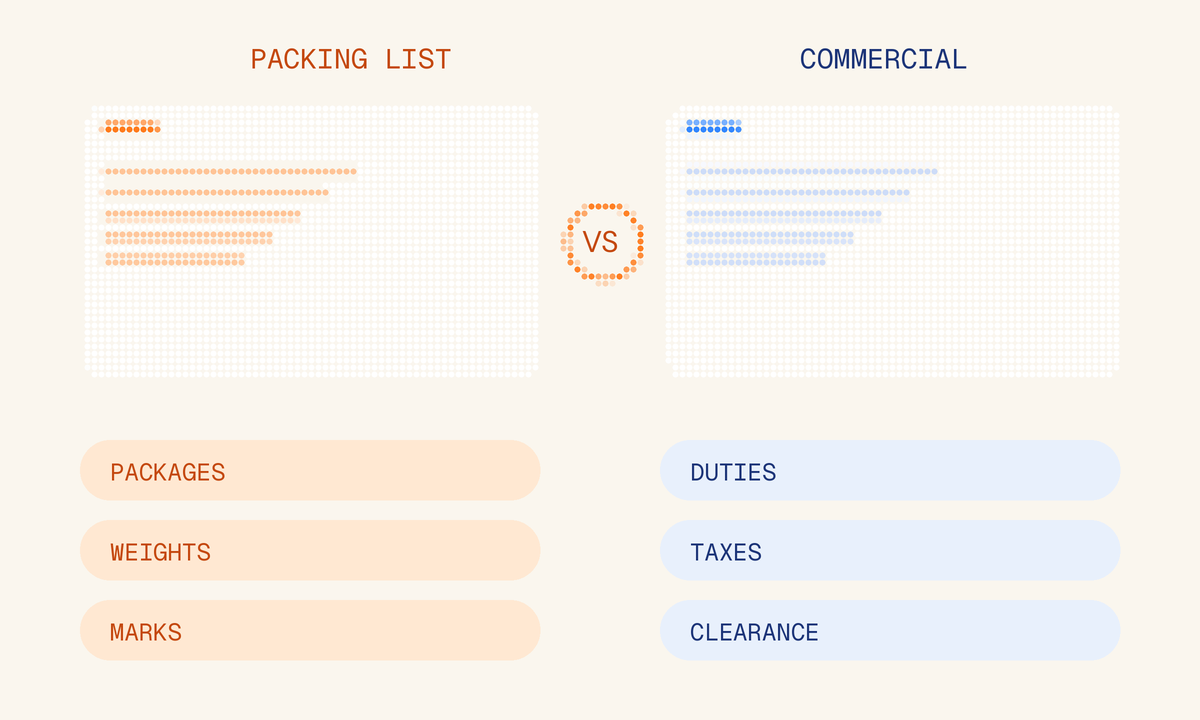
| Packing list | Commercial invoice | |
|---|---|---|
| Main job | Describes how goods are packed (packages, weights, marks, dimensions) (ITA) | Used by customs when assessing import duties and taxes (ITA) |
| Prices / payment | No sale price or payment terms on the packing list | Sale value and payment terms sit on the commercial invoice (practice; not an ITA packing-list claim) |
| Can it stand alone? | Not a substitute for a commercial invoice | Required clearance document for the sale |
| Must match | Same goods, quantities, and package facts as the invoice | Should reflect the packing list |
For the bill that clears the goods, see proforma invoice vs commercial invoice. For the full per-shipment set, see the export documentation checklist.
What fields go on an export packing list?
Copy this field checklist into your spreadsheet or letterhead. Core rows follow ITA’s common export documents packing-list description (seller, buyer, shipper, invoice number, date of shipment, mode, carrier, quantity, description, package type and count, net and gross weight in kilograms, marks, and dimensions when appropriate):
| # | Field | Notes |
|---|---|---|
| 1 | Seller’s name and address | Same legal seller as on the commercial invoice |
| 2 | Buyer’s name and address | Match the invoice / purchase order |
| 3 | Shipper (if different) | Who hands cargo to the carrier |
| 4 | Invoice number and date | Tie the list to this shipment’s commercial invoice |
| 5 | Date of shipment | Actual or planned ship date for this booking |
| 6 | Mode of transport | Sea, air, road, rail—as booked |
| 7 | Carrier | Vessel / airline / trucker name if known |
| 8 | Package type and count | Box, crate, drum, carton, pallet; number of packages |
| 9 | Marks and numbers | Marks printed on outer packaging |
| 10 | Description of goods | Same family of words as the commercial invoice |
| 11 | Quantity per package / total quantity | Units that match the invoice |
| 12 | Net weight | Goods only; ITA notes kilograms are common |
| 13 | Gross weight | Goods plus packaging |
| 14 | Dimensions (when appropriate) | Per package or as your forwarder asks |
| 15 | Totals | Total packages, total net weight, total gross weight |
ITA also notes that commercial stationers and freight forwarders carry packing-list forms, and that a packing list may serve as a conforming document in some document presentations (common export documents).
HS codes belong on the commercial invoice when you include them (ITA commercial invoice); do not treat the packing list as the place where classification is decided. For a starting lookup only, see EximAgent’s HS code tool.
How do you keep the packing list aligned with the invoice?
Before you release documents, check that the packing list and commercial invoice tell the same story:
- Product description wording
- Quantities and units
- Package counts and marks
- Invoice number and shipment date
- Shipper / seller / buyer names
ITA states that U.S. and foreign customs may use the packing list to check cargo, so the commercial invoice should reflect the information shown on the packing list.
Once the lines agree, EximAgent Compliance can help your team check HS codes and duties on the shipment.
EximAgent doesn't prepare the documents themselves.
When should you prepare the packing list?
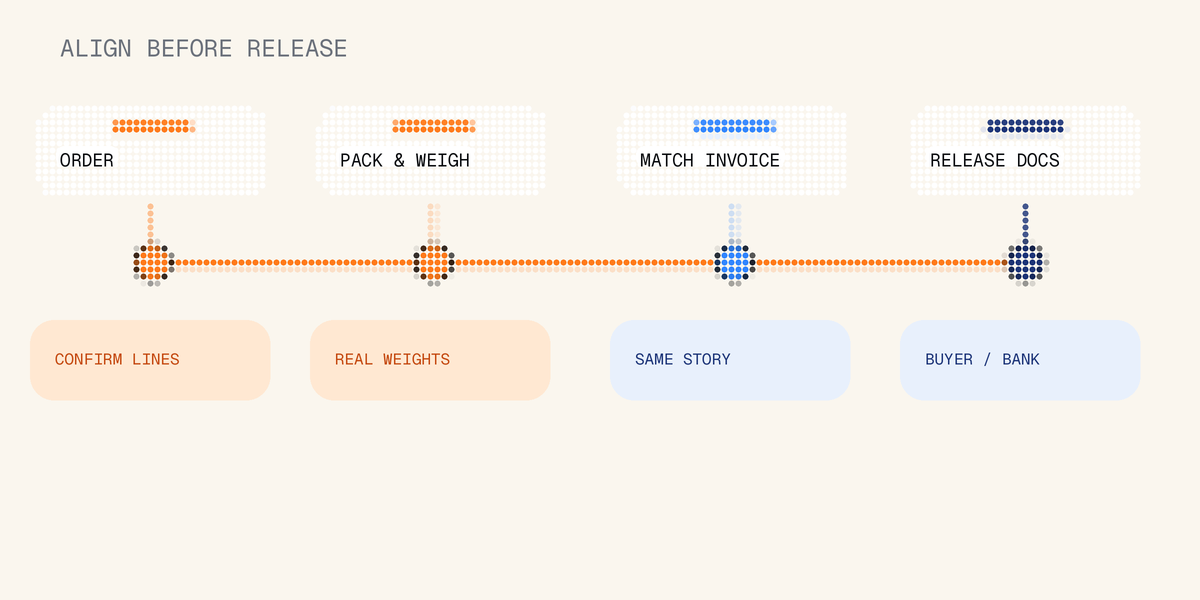
- Order confirmed — freeze product lines and quantities.
- Cargo packed — weigh and measure packages; do not invent weights.
- Commercial invoice drafted — pull seller, buyer, invoice number, and descriptions from the same source file.
- Booking / SI cut-off — share the list with your forwarder so they can confirm freight and, if needed, container stuffing details.
- Documents released — include the packing list in the set you send the buyer, bank, or broker, per the export documentation checklist.
If packing changes after the first draft (extra carton, different marks), revise the packing list and the commercial invoice together.
FAQ
Is a packing list the same as a packing slip?
For export, treat them differently. ITA describes an export packing list as considerably more detailed than a standard domestic packing list, with seller, buyer, shipper, invoice, mode, carrier, package type and count, weights, marks, and dimensions.
Does the packing list replace the commercial invoice?
No. ITA states a packing list is not a substitute for a commercial invoice.
Who uses the packing list?
Freight forwarders use it for weights and freight costs; U.S. and/or foreign customs may use it to check package contents (ITA packing list).
Should weights be in kilograms?
ITA’s common-export-documents note lists total net and gross weight in kilograms among typical export packing-list fields. Confirm any buyer- or carrier-specific unit rules with your forwarder.
Where can export teams go next?
Start free with EximAgent: Analyst finds the market and buyers, and Compliance checks HS codes and duties before you ship.
Sources
- ITA, Packing List — verified HTTP 200
- ITA, Common Export Documents — verified HTTP 200
- ITA, Commercial Invoice — verified HTTP 200
- ITA, Pro Forma Invoice — verified HTTP 200
- ITA, Harmonized System (HS) Codes — verified HTTP 200