Guides · Export paperwork
Export Documentation Checklist: Per-Shipment Guide
Use this export documentation checklist per shipment: commercial invoice, packing list, transport docs, and extras.
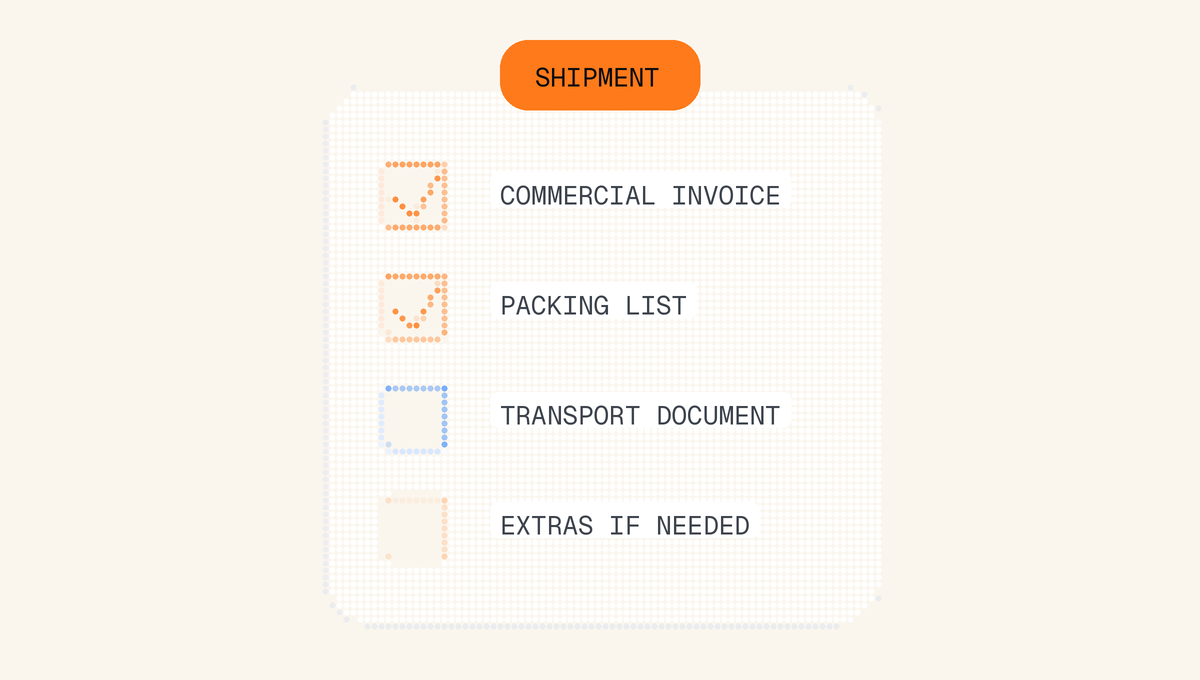
An export documentation checklist is the set of papers you assemble for each shipment so the buyer can clear customs and take delivery. ITA’s common export documents list centers on a commercial invoice, a detailed packing list, and a transport document (ocean bill of lading or air waybill). Destination, product, and payment method then add extras such as a certificate of origin or inspection certificate. Start from the buyer and your forwarder, then tick the list below before cargo leaves.
Which documents does every export shipment need?
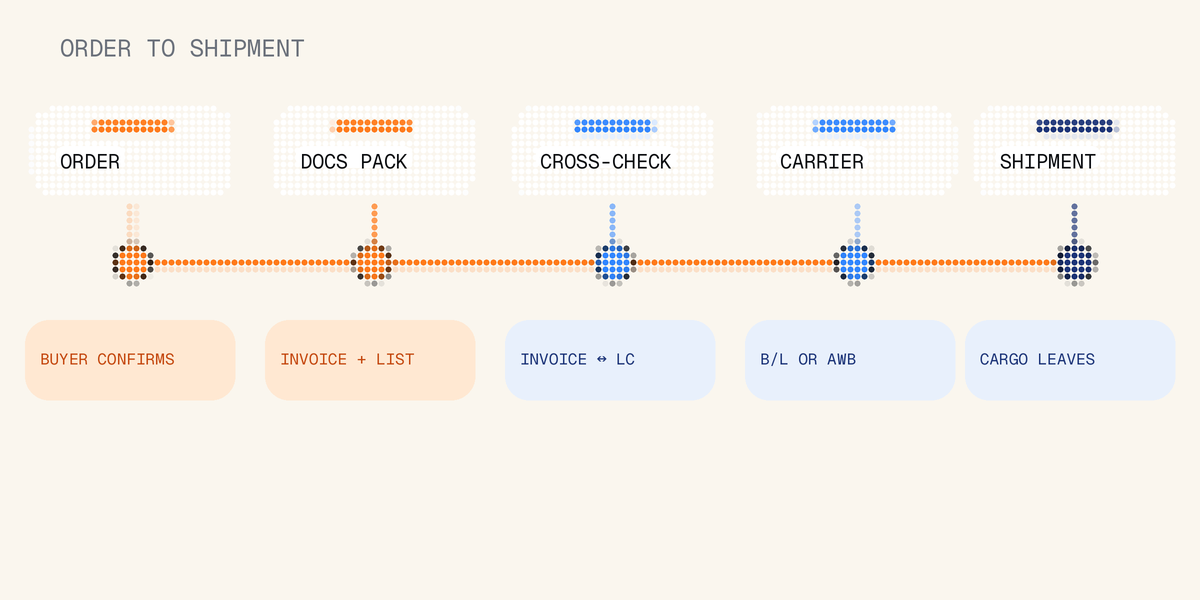
The ITA common export documents page is the baseline. ITA’s special documents guidance also says to ask the foreign buyer early which documents their customs will need.
| Document | Usually needed? | What it does |
|---|---|---|
| Commercial invoice | Yes | Bills the buyer; customs uses it for duties |
| Packing list | Yes | Line-by-line packages, weights, marks |
| Ocean bill of lading or air waybill | Yes (mode-specific) | Contract with the carrier / proof for delivery |
| Proforma invoice | Before shipment (deal stage) | Quote for LC, license, or payment setup — not the clearance set |
| Certificate of origin | When the buyer/country asks | States origin; may be chamber-certified |
| Export license / control docs | When rules require | Authorizes controlled goods or destinations |
| Insurance certificate | When Incoterm or contract requires | Evidence of cargo insurance |
| Inspection / sanitary / other certificates | Product- or market-specific | Health, safety, quality, or conformity |
Special cases (FTA certificates, consular invoices, carnets, and product certificates) sit under ITA’s special documents guidance—confirm them early, not at the pier.
What belongs on the commercial invoice and packing list?
Commercial invoice
Treat the commercial invoice as the legal bill for this shipment. It should state the goods, quantities, prices, parties, Incoterm and named place, payment terms, and (where useful) HS codes. See ITA’s commercial invoice note, and our field-by-field comparison in proforma invoice vs commercial invoice.
For classification help when you add HS codes, use EximAgent’s HS code tool as a starting point—your team still owns the final code.
Packing list
An export packing list itemizes the contents of each package (weights, measurements, and goods). ITA’s common export documents overview adds typical fields such as seller, buyer, shipper, invoice number, date, mode, carrier, package type and count, net and gross weight (often in kilograms), marks, and dimensions. It is not a substitute for the commercial invoice; the two should agree.
What transport document do you need?
- Ocean freight: a bill of lading (ITA describes straight/non-negotiable and negotiable or shipper’s order forms). The customer often needs an original to take delivery.
- Air freight: an air waybill (carrier-specific; ITA notes air waybills are not negotiable like order bills of lading).
This guide does not walk through bill-of-lading types in depth. Confirm the exact form with your carrier or forwarder for the booking you placed.
Per-shipment export documentation checklist
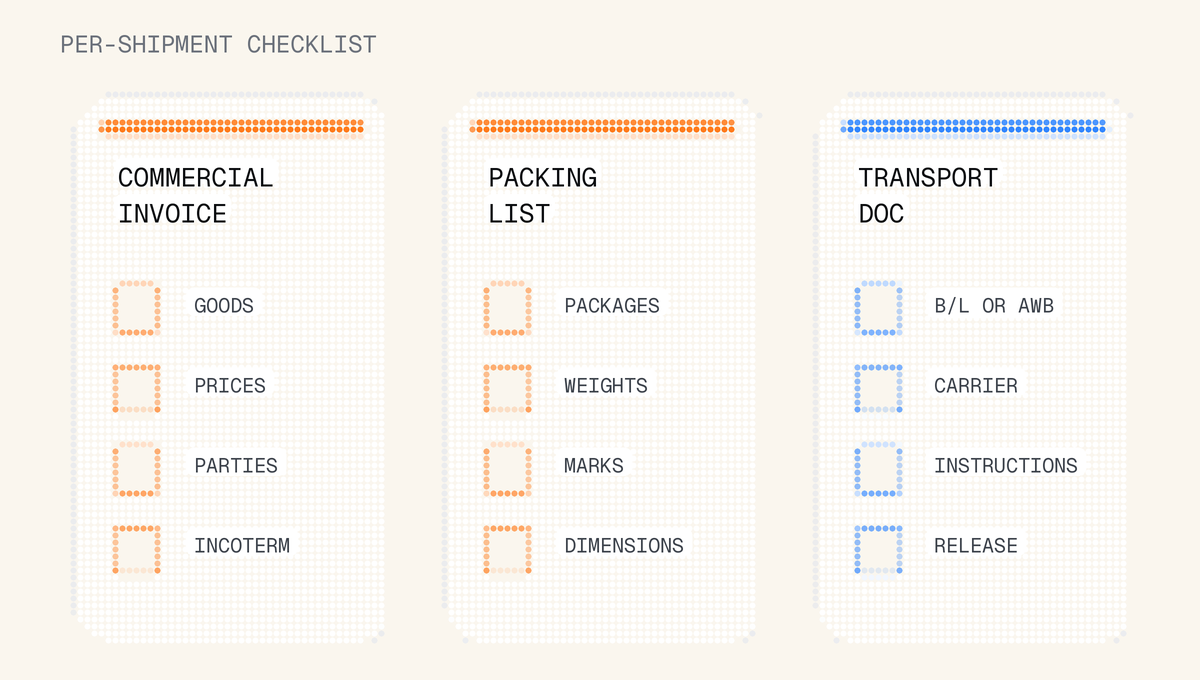
Print or copy this table into your shipment folder. Tick Owner as the person who produces the file; tick Done only when the PDF/original is in the pack.
| # | Document / task | When | Owner | Done |
|---|---|---|---|---|
| 1 | Confirm destination document list with buyer + forwarder | Before booking | Sales / Ops | ☐ |
| 2 | Proforma agreed (price, Incoterm, qty, validity) | Before LC / payment setup | Sales | ☐ |
| 3 | Commercial invoice drafted from the final order | After booking / before cargo cut-off | Docs | ☐ |
| 4 | Packing list matches invoice lines and package counts | Same time as invoice | Warehouse / Docs | ☐ |
| 5 | HS codes reviewed on the commercial invoice | Before issue | Compliance | ☐ |
| 6 | Certificate of origin (generic or FTA) if required | Per destination rules | Docs / Chamber | ☐ |
| 7 | Licenses, destination-control, or other control statements if required | Before export | Compliance | ☐ |
| 8 | Insurance certificate if the Incoterm/contract needs it | Before sailing/flight | Ops / Broker | ☐ |
| 9 | Inspection, sanitary, or conformity certificates if required | Lead time varies | QA / Supplier | ☐ |
| 10 | Transport document (B/L or AWB) instructions sent to carrier | At booking / SI cut-off | Ops | ☐ |
| 11 | Cross-check: invoice ↔ packing list ↔ LC (if any) ↔ booking | Before documents are released | Docs lead | ☐ |
| 12 | Final set shared with buyer / bank / broker as agreed | After issue | Docs | ☐ |
U.S. exporters may also need to file Electronic Export Information (EEI) through AES when filing rules apply—see ITA’s common export documents note on EEI/AES and confirm with your forwarder. That filing is separate from the commercial set you send the buyer.
How do you adapt the checklist by destination or product?
- Ask first. ITA calls asking the foreign buyer which documents their customs needs a best practice.
- Read a Country Commercial Guide for import requirements and documentation chapters (custom requirements overview).
- Product overlays. Food, chemicals, dual-use goods, and medical products often need certificates the general table does not list.
- Payment overlays. Letters of credit add bank presentation rules on top of customs rules—build them into row 11.
- Do not invent duty rates. Other duties or measures may apply beyond a headline tariff; use official schedules or a licensed broker.
When your documents agree and you want a second pass on codes and duties, EximAgent Compliance checks HS codes and duties. For import-side document questions tied to HS codes, see EximAgent’s guide on import documents required by HS code.
EximAgent doesn't prepare the documents themselves.
FAQ
What is the minimum export documentation checklist?
For a typical commercial shipment: commercial invoice, packing list, and the transport document for your mode. Everything else depends on destination, product, and contract.
Is a packing list enough without a commercial invoice?
No. ITA states a packing list is not a substitute for a commercial invoice.
Do I always need a certificate of origin?
No. ITA notes certificates of origin are required by some countries for all or certain products and are often validated by a chamber of commerce; free-trade claims use their own origin certification rules (special documents). Confirm with the buyer.
Where does the proforma invoice fit?
At the deal stage—before you ship—so the buyer can open an LC or arrange import formalities. The shipment pack uses the commercial invoice. Details: proforma vs commercial invoice.
Where can export teams go next?
Start free with EximAgent: Analyst finds the market and buyers, and Compliance checks HS codes and duties before you ship.
Sources
- ITA, Common Export Documents — verified HTTP 200
- ITA, Commercial Invoice — verified HTTP 200
- ITA, Packing List — verified HTTP 200
- ITA, Special Documents — verified HTTP 200
- ITA, Custom Requirements and Documentation: Country Commercial Guides — verified HTTP 200
- CBP, Basic Import and Export — verified HTTP 200