Guides · Export paperwork
Proforma Invoice vs Commercial Invoice with Field Checklist
Compare a proforma invoice and a commercial invoice field by field, plus a field checklist of what to include.
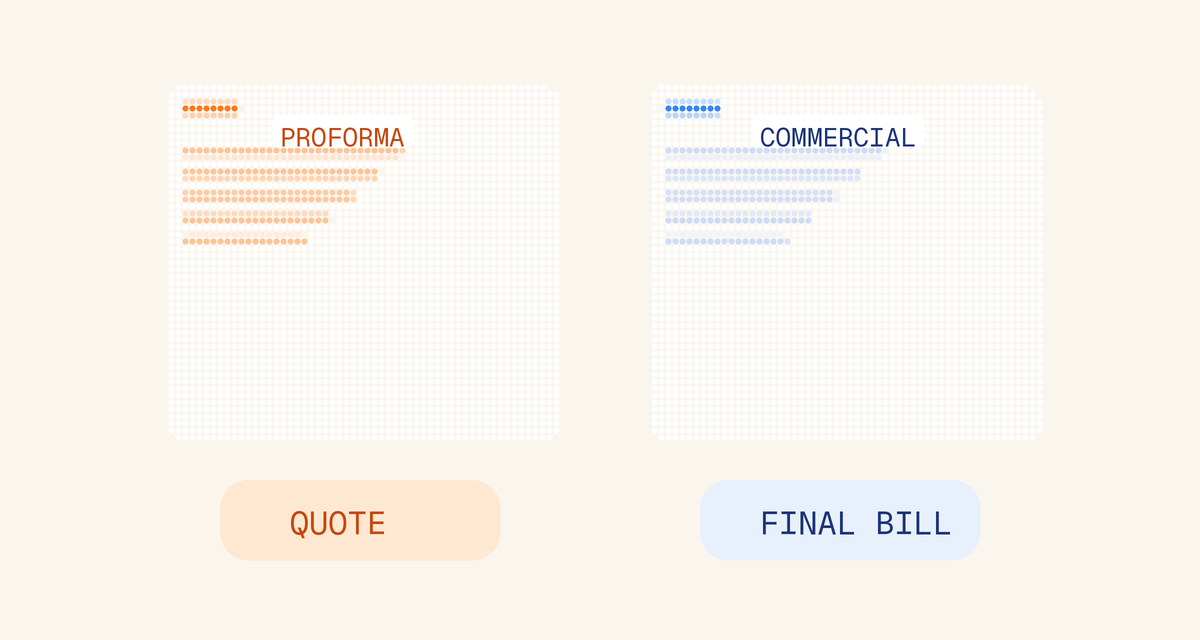
A proforma invoice is a quote in invoice form that buyers use before shipment (for import licenses, letters of credit, or payment setup). A commercial invoice is the final bill used for export and import clearance and for assessing duties. Use a proforma early in the deal; switch to a commercial invoice when the goods actually ship. The field checklist below lists what each document needs.
What is a proforma invoice?
A pro forma invoice is a quote in an invoice format. The U.S. International Trade Administration (ITA) notes that buyers may need it to apply for an import license, arrange pre-shipment inspection, open a letter of credit, or transfer hard currency, and that a pro forma may not be a required shipping document.
Include a validity date for the offer, and do not change agreed details without the buyer’s consent (ITA). ITA’s quotations and pro forma guidance also says to mark the document clearly as a pro forma invoice.
What is a commercial invoice?
A commercial invoice is a required document for export and import clearance. It bills the buyer for the goods sold and is one of the main documents customs uses to assess import duties and taxes. Some destinations also use it for foreign-exchange controls and specify form, copies, or language.
Before you ship to a new market, check country-specific invoice rules with your buyer, freight forwarder, or a Country Commercial Guide—not from memory.
Proforma invoice vs commercial invoice: what’s the difference?
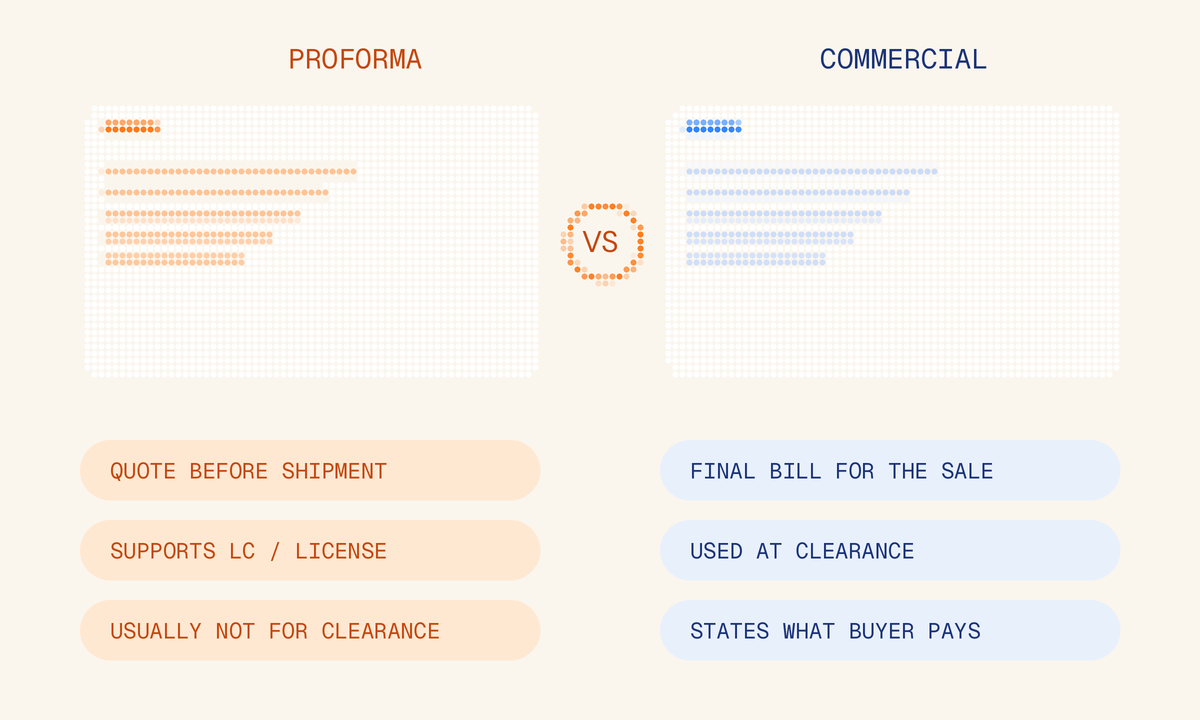
| Proforma invoice | Commercial invoice | |
|---|---|---|
| Role | Quote / negotiating tool before shipment | Final bill for the sale (ITA) |
| When you issue it | After inquiry or before LC / import license | At or just before shipment |
| Customs clearance | Often not a required shipping document (ITA) | Required for export/import clearance; used to assess duties (ITA) |
| Payment | Helps the buyer open an LC or arrange funds; not used for payment purposes on its own | Bill for the goods; used with customs for duties |
| Price status | Offer; include a validity period | Agreed sale price for this shipment |
| HS codes | Optional / helpful | May include HS codes to speed clearance |
| Label on the page | Should be clearly marked “pro forma invoice” (ITA quotations guidance) | Final commercial invoice for the shipment |
| Changes | Do not change without buyer consent | Should match the packing list (ITA) |
ITA’s common export documents overview places the pro forma at the start of the deal as a negotiating tool that leads into the final commercial invoice used when goods clear customs.
What fields go on a proforma invoice template?
Copy this field checklist into your spreadsheet or letterhead. The core rows match the ITA pro forma invoice list:
| # | Field | Notes |
|---|---|---|
| 1 | Seller’s name and address | From the ITA list |
| 2 | Buyer’s name and address | Match the name used on any LC or import license when you can |
| 3 | Buyer’s reference | Inquiry or PO number |
| 4 | Items quoted | Clear product descriptions |
| 5 | Prices of items | Per unit and extended totals |
| 6 | Weights and dimensions of quoted products | Packed for export |
| 7 | Discounts, if applicable | — |
| 8 | Terms of sale or Incoterm used (include delivery point) | Name the rule and place; see Know Your Incoterms (ICC rules summarized by ITA) |
| 9 | Terms of payment | e.g. TT, LC |
| 10 | Estimated shipping date | Estimate, not a booking confirmation |
| 11 | Validity date | How long the quote stands |
ITA’s quotations and pro forma guidance also recommends stating the currency of sale, marking the page pro forma invoice, and adding a country of origin statement plus a line certifying the pro forma is true and correct.
Keep the commercial invoice as a sibling of this checklist so the final bill reuses the same product lines, Incoterm, and payment terms.
What extra fields does a commercial invoice need?
Start from the same rows as the proforma, then add what clearance needs:
- Invoice number and invoice date for this shipment (standard practice so the file can be referenced)
- Actual quantities shipped, aligned with the packing list (ITA notes customs may check cargo against the packing list)
- Harmonized System (HS) codes — ITA says the commercial invoice may include the HS code; look up codes on EximAgent’s HS code tool only as a starting point
- Destination control statement when your export rules call for one (ITA commercial invoice; not required for every export)
- Other party or charge lines your forwarder or buyer asks for (for example shipper/consignee details, or freight and insurance under your Incoterm)
For U.S. import entry, CBP rules generally require a commercial invoice, with limited exceptions where a substitute/pro forma invoice may be filed. Clearance rules in the buyer’s country still control their import. Check country-specific invoice rules in a Country Commercial Guide.
When should you send each document?
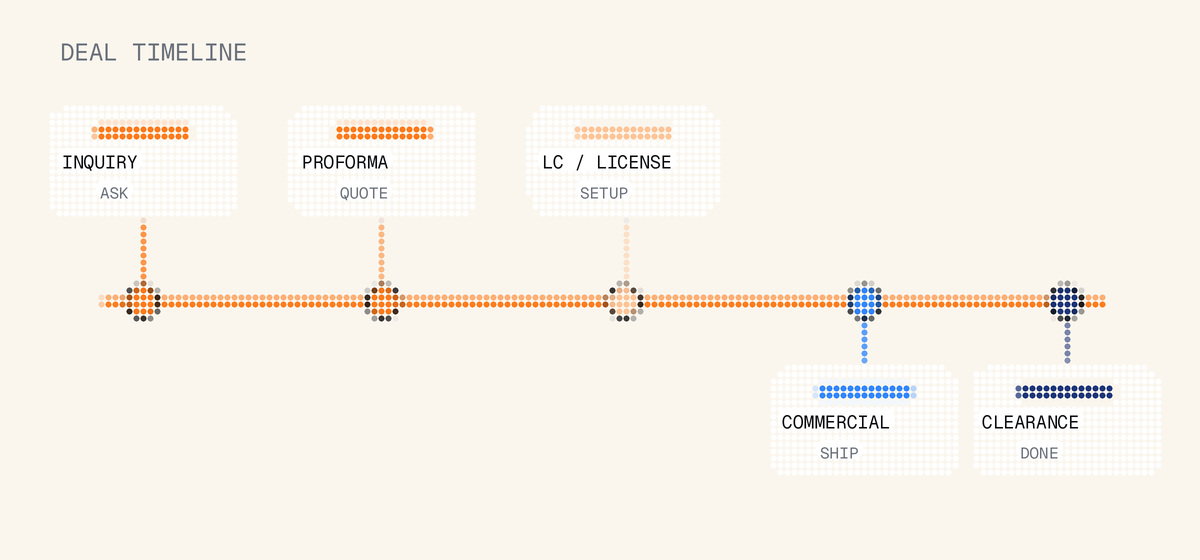
- Inquiry → reply with a quotation or proforma invoice.
- Buyer opens an LC or applies for an import license → they often use your proforma as the supporting quote (ITA).
- Order confirmed and cargo booked → prepare the commercial invoice and packing list together.
- Goods ship → commercial invoice travels with the shipment set (with the transport document your carrier issues).
If numbers change after the proforma (quantity, price, Incoterm), issue a revised proforma before the commercial invoice, and get the buyer’s OK.
How do you keep the two invoices consistent?
Mismatches between the proforma, commercial invoice, packing list, and letter of credit can delay clearance or LC payment. Before you release documents, check:
- Product description wording (same family of words on every doc)
- Quantities, units, and package counts
- Unit prices and totals
- Incoterm and named place
- Currency
- HS codes once you add them to the commercial invoice
Once the paperwork lines up, EximAgent Compliance can help your team check HS codes and duties on the shipment.
EximAgent doesn't prepare the documents themselves.
For the wider document set around each shipment, see the export documentation checklist.
FAQ
Is a proforma invoice a legal invoice for payment?
No. ITA describes it as a quote in invoice format and states that pro forma invoices are not used for payment purposes. Buyers use them for licenses, LCs, and planning. The commercial invoice is the bill for the goods (ITA).
Can a proforma invoice clear customs?
Usually no. ITA treats the commercial invoice as a required clearance document used to assess duties. For U.S. import entry, a substitute/pro forma invoice is allowed only in narrow cases when a commercial invoice is not required or available—do not plan on that as your normal export process.
Do I need HS codes on the proforma?
Not always. They are more important on the commercial invoice. Adding them early still helps the buyer estimate duties. Use a proper classification process; HS code lookup is a starting point, not a substitute for your compliance review.
Should the commercial invoice match the packing list?
Yes. ITA’s common export documents note says U.S. and foreign customs may use the packing list to check cargo, so the commercial invoice should reflect the same information.
Where can export teams go next?
Start free with EximAgent: Analyst finds the market and buyers, and Compliance checks HS codes and duties before you ship.
Sources
- ITA, Pro Forma Invoice — verified HTTP 200
- ITA, Quotations and Pro Forma Invoices (beta) — verified HTTP 200
- ITA, Country Commercial Guides — customs documentation — verified HTTP 200
- ITA, Commercial Invoice — verified HTTP 200
- ITA, Common Export Documents — verified HTTP 200
- ITA, Harmonized System (HS) Codes — verified HTTP 200
- ITA, Know Your Incoterms — verified HTTP 200
- eCFR, 19 CFR 141.83 Type of invoice required — verified HTTP 200